Volunteer Sessions 2025 Wrap-up

It doesn’t feel too long since I wrote a post about the end of 2024, but 2025 has been a really busy and varied year for our Rivers & People volunteers. Firstly, I want to extend a HUGE thank you to everyone who helped out at one of our 36 sessions this year. We covered all three rivers within Lewisham, and miles of banksides, surveying for wildlife, litter-picking, restoration projects within the channel to improving access to the river from within the parks. Overall, 693 volunteer hours have been given to the rivers in Lewisham, so thank you to everyone who has been involved.

To join the Rivers & People volunteer group in 2026, please check out our January-March session programme.

Rivers & People Volunteer Programme [January – March 2026]

The volunteer session programme has now been released for January – March 2026. Check out the programme HERE. If you would like to get involved in volunteering on Lewisham’s rivers please read through the the River Volunteering web page, and if you have any questions or queries please get in touch with Emily.

Volunteer Sessions in May

We had slightly less sessions in May due to some staff annual leave, but the sessions we had were full on! From clearing the weir in Ladywell Fields, and getting that water flowing through all the rocks to heading back to the willow lined Quaggy in Chinbrook Meadows. In this latter location we manage the veegtation that grows into and through the boardwalk to keep it accessible for everyone to walk through the ponds and over the river here on the pathways.

Above the Ravensbourne on the bridge to St Mary’s Churchyard and gardens we met a familiar avian face; a pair of mandarin ducks who have called this stretch of river home for the past three years. We know its the same female mandarin as she has a twisted lower bill, so she stands out, we also imagine she gets a lot of food from park visitors as she has certain grown in confidence as she was the first bird to fly up and ask for crumbs (swiftly followed by the male, pictured above, then some feral pigeons)!

Volunteer Sessions in April

We’ve been all over the borough this April! Starting out at Cornmill gardens, located behind Lewisham Town Centre, we did a litter pick upstream towards Riverdale Sculpture trail. We removed a whopping 9 full bags of rubbish and a large shopping trolley from this section of the river. We also observed a large shoal of Chub and spotted one small European Eel slightly upstream of this park.

Lots of work has been happening in the east side of Beckenham Place Park, so it’s been a while since we’ve waded this section. We found some interesting things in the river including a collection of little plastic fish floating downstream towards, they were a bit brighter coloured than the fish we normally find!

Heading into the Quaggy later in the month, heading downstream from Manor Park to behind the Lidl on Lee High Street. Although still early in the growing season we did find a bunch of Himalayan Balsam, which we removed on our wade downstream.

Volunteer Sessions in March

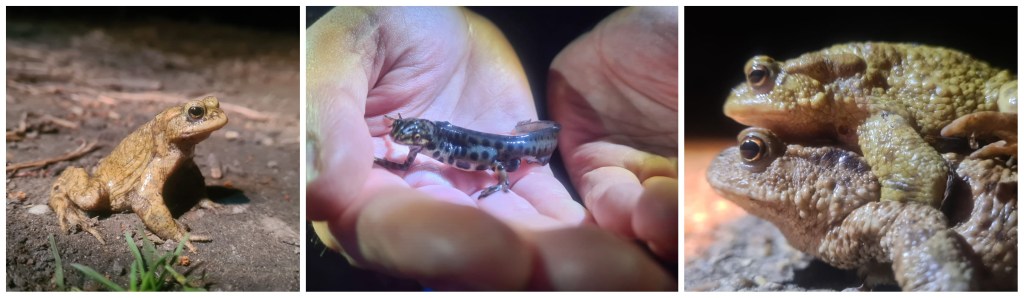
March means Amphibians! As the amphibian migration begins, we start to check all the ponds within Lewisham for signs of amphibian presence. This year we visited Bell Green Pond, in Linear Park and Chinbrook Community Orchard. We change our session time from 11am-2pm to evening sessions 4.30pm-7pm to catch dusk into darkness where we can practice many different amphibian survey techniques.

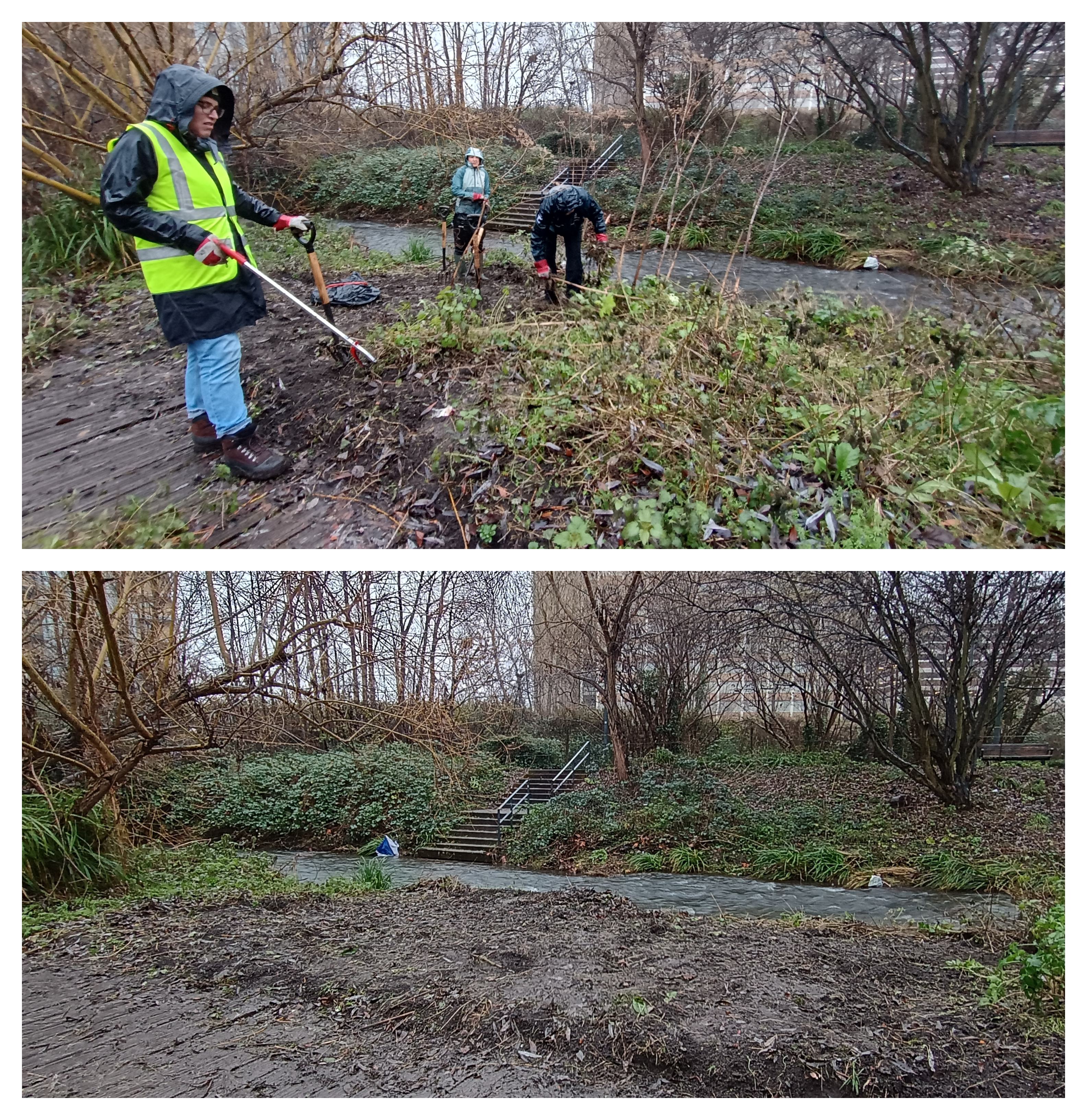
If you’ve been reading the blog over the past year, you may remember we’ve been working on the hub area of Ladywell Fields (South), previously digging up the brambles and reducing nettles etc in 2 of the 4 areas. In March we returned to plant up marginal plants at the bottom next to the river and a wildflower mix of plug plants and seeds for the rest of the slope.

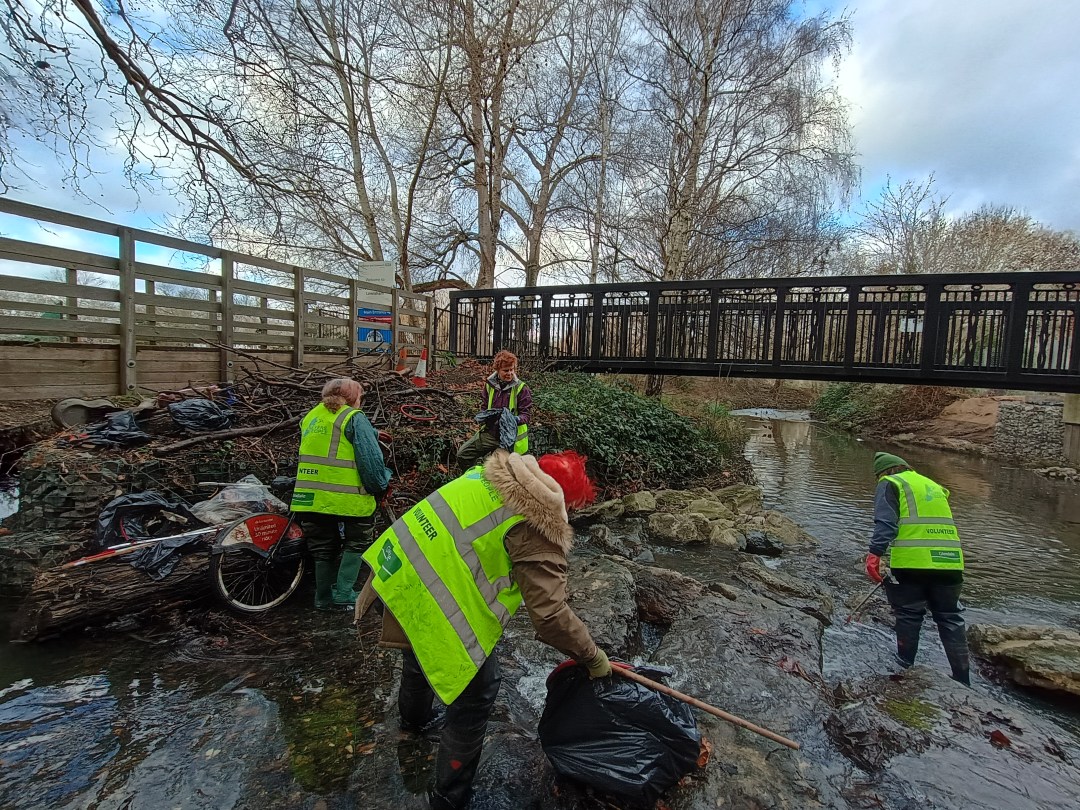
We donned our waders and started our quarterly clean up of the River Ravensbourne working from Ladywell Road up to Lewisham Hospital and then around the secondary channel.

FREE Riverfly Training Course

Join Thames21 for a free training course to become an urban riverfly monitor. Find out more and book onto the course HERE

Date: 23rd April 2025

Venue: Manor Park Classroom, Manor Park, SE13 54L

Timings: 09:15 – 16:00 (more details are in the below table). Please note, timings are slightly flexible so we may finish slightly earlier than 16:00.

Structure of the day:

09:15 = Arrivals, registration and refreshments

09:30 = Intros, health & safety and biosecurity

10:00 = Introduction to Riverfly monitoring (RMI)

10:20 = BREAK (tea/coffee)

10:30 = Target groups – identification, life history & ecology

11:10 = BREAK (tea/coffee)

11:20 = RMI fieldwork – theory

11:45 = BREAK (early lunch. You can instead eat later if you like!)

12:15 = RMI fieldwork – practical session in the river

14:30 = Clean equipment and kit

15:15 = ID quiz (back inside the pavilion)

15:20 = Online database and RMI in practice

13:45 = Questions and feedback

16:00 = Finish

Getting there: Please note this is not a very car friendly area, so driving in isn’t the best option for any attendees unless they can find paid parking nearby. There are multiple entrances into the park and it is well serviced by bus routes and Hither Green train station which is nearby (7 minute walk). 

Lunch: Please bring your own lunch with you, or there will be time during the break to buy some. Please also bring a water bottle with you.

Clothing: Please dress appropriately for the weather: bring lots of layers and warm clothes for the practical bit outside! If there is rain in the forecast, bring a raincoat. In general for riverfly monitoring, please wear long trousers and wear or bring a long-sleeved top/fleece/jumper to protect yourself from nettles or giant hogweed. Please also wear sturdy shoes for the walk to the site for the practical session.

Waders: Please let us know what your shoe size is ASAP so we can make sure to bring enough waders to fit everyone. We won’t be able to let you keep these waders unfortunately – they will just be loaned to you for the training day. Also, please let us know if you are going to bring your own waders. 

Equipment: All equipment for the RMI practical fieldwork will be provided on the day – we will give you / the person representing your group monitoring kit to take home with you. This kit includes: a large net (approximately 1.5m tall so I would advise not cycling if you are the designated person in your group who is taking the net home), a 16 litre bucket, a large white tray, a nine-section divided tray, a large pipette, a couple of small pipettes, a couple of plastic spoons, a magnifying glass and a paintbrush.

Let us know if you have any questions by emailing at jack.beard@thames21.org.uk or calling 07597576706

Volunteer Sessions in February

Lots happening in February! We spent most of this month’s sessions in Northbrook Park, near Grove Park station, working both within the park’s new wetland area and just across the boundary on Network Rail’s land to improve the wet woodland and the park’s stream of water that flows into it. The image below shows the channel from the second pond in the stream being widened and graded to allow the flowing water to spread out into the woodland (where the photo was taken).

On the park’s side of the fence we have been processing the limbs and branches of a few trees that have come down in recent high winds and working with local schools to help plant up the pond and the banks.

We then ventured further south into the borough to Chinbrook Meadows, where we have to keep on top of teh growth of the willows along the stretch of river (and overhanging the paths and boardwalks). In addition to dead hedges, woven fences we’ve also created some hexagonal and pentagonal dead wood piles to allow the sneadings to be kept on site in a neat but still great for wildlife purpose! These worked really well, so look out for them in other parks across the borough soon.

Volunteer Sessions in January

January began as a frosty month, where we finished up our work on a section of reeds in the Hare & Billet pond, Blackheath. We’ll return next winter to tackle the next area of reeds, as we cut areas back on rotation

Elsewhere in the borough, we were planting native black poplar trees along the River Pool, we planted 5 trees, 3 male and 2 female along the stretch of the river and installed protective cages around them to give them time to grow large enough without any disturbance.

DID YOU KNOW? Only around 7,000 wild black poplars now grow in Britain and of these, only 600 are female trees.